

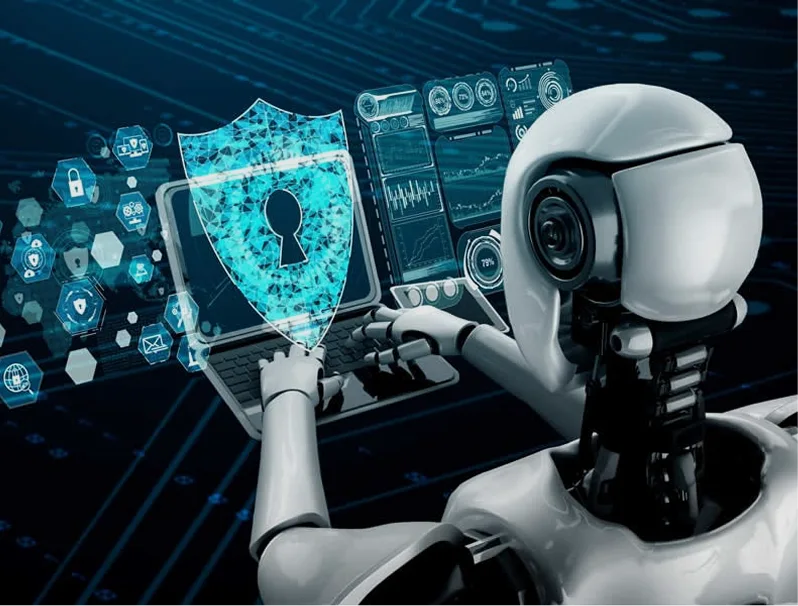
What Is AI Driven Cybersecurity?
AI driven cybersecurity is the use of artificial intelligence and machine learning technologies to improve how an organisation detects, analyses, prevents and responds to cyber threats.
Traditional cybersecurity tools often rely on predefined rules, signatures and known indicators of compromise. These controls remain important, but modern attacks can change quickly, use previously unseen techniques or generate large numbers of security events.
AI can analyse security information at a much larger scale and identify patterns that may be difficult for human security teams to detect manually.
For example, an AI-powered security system may analyse:
- Network traffic
- User login behaviour
- Endpoint activity
- Application activity
- System logs
- File behaviour
- Email activity
- Access patterns
- Security alerts
- Threat intelligence
- Cloud activity
The system can then identify unusual behaviour, prioritise potential threats and provide security teams with information for further investigation.
In simple terms, AI driven cybersecurity helps organisations move from relying only on predefined security rules towards a more adaptive and data-driven approach to threat detection.
How Does AI Driven Cybersecurity Work?
AI driven cybersecurity generally works by collecting and analysing security data from different parts of an IT environment.
The process can be understood through several key stages.
1. Collecting Security Data
The first step is collecting security information from endpoints, networks, applications, users and other systems.
A business may generate thousands or even millions of security events. These can include login attempts, network connections, file changes, application activity and unusual access requests.
AI systems can process this information continuously instead of requiring security teams to manually review every event.
2. Establishing Normal Behaviour
AI and machine learning systems can analyse historical activity to establish patterns of normal behaviour.
For example, an employee may normally log in from Malaysia during standard working hours and access a predictable set of business applications.
If the same account suddenly attempts to access systems from an unusual location, downloads an unusual volume of data or performs activities outside its normal pattern, the activity may be flagged for investigation.
This approach is known as behavioural analysis or anomaly detection.
3. Detecting Anomalies and Potential Threats
Once normal patterns have been established, AI can identify deviations that may indicate suspicious activity.
These deviations do not automatically mean an attack has occurred. However, they can provide an important signal for security teams to investigate.
AI-based detection can therefore help identify suspicious behaviour that may not match a known malware signature or predefined security rule.
4. Analysing and Prioritising Alerts
Security environments can generate a large number of alerts. One of the challenges for security teams is determining which events require immediate attention.
AI can help analyse multiple signals and identify relationships between them.
For example, a suspicious login followed by unusual endpoint activity and unexpected network communication may be more significant when considered together than when each event is viewed separately.
This can help security teams focus their attention on higher-risk events.
5. Supporting Automated Response
Depending on the security platform and configuration, AI-powered cybersecurity can support automated or semi-automated responses.
Possible actions may include isolating an endpoint, blocking suspicious activity, restricting access or escalating an alert to a security analyst.
Human oversight remains important, particularly for high-impact security decisions. AI should support security professionals rather than replace the overall cybersecurity strategy.
AI Driven Cybersecurity vs Traditional Cybersecurity
AI driven cybersecurity does not mean replacing every traditional security control.
Firewalls, endpoint protection, access controls, authentication, vulnerability assessments and other established security technologies remain important.
The difference is how intelligence is applied across the security environment.
| Traditional Cybersecurity | AI Driven Cybersecurity |
| Relies heavily on predefined rules | Uses data-driven analysis |
| Often focuses on known threats | Can identify unusual behaviour and patterns |
| Manual investigation can be extensive | Helps automate analysis and prioritisation |
| Static rules require updating | Models can adapt to changing patterns |
| Large alert volumes can overwhelm teams | Helps prioritise potentially important events |
| Primarily reactive in some environments | Supports more proactive threat detection |
What Are the Benefits of AI Driven Cybersecurity?
1. Faster Threat Detection
Cyberattacks can develop quickly. AI can analyse security data continuously and help identify suspicious activity without waiting for a manual review of every event.
Faster detection gives security teams more opportunity to investigate and contain potential threats before they cause greater damage.
2. Improved Detection of Unusual Behaviour
Some attacks may not immediately match known signatures.
AI-based behavioural analysis can look for deviations from expected activity, helping security teams investigate suspicious behaviour that may otherwise be overlooked.
3. Reduced Security Alert Overload
A large number of alerts can make it difficult for security teams to determine what matters most.
AI can help analyse and prioritise security events, allowing analysts to focus their time on potentially higher-risk activity.
4. Continuous Security Monitoring
AI-powered systems can support continuous monitoring of endpoints, networks and other parts of an IT environment.
This is particularly useful for organisations with distributed infrastructure, remote users, cloud environments and multiple endpoints.
5. Faster Incident Response
When suspicious activity is detected, rapid response can help limit the potential impact.
AI-powered security solutions can support automated or guided responses, depending on the technology deployed and the organisation’s security policies.
6. Better Visibility Across the IT Environment
Modern businesses often operate across offices, cloud platforms, endpoints, networks and remote connections.
AI-driven security can help analyse signals from different environments and provide security teams with a broader view of potential threats.
How to Choose an AI Driven Cybersecurity Solution?
There is no single AI cybersecurity solution that is suitable for every organisation.
The right approach depends on the organisation’s infrastructure, industry, data, users, risk profile and existing security controls.
Assess Your Current Security Environment
Start by identifying the systems that need protection.
This may include:
- Employee endpoints
- Servers
- Corporate networks
- Cloud infrastructure
- Business email
- Applications
- Databases
- Remote access systems
Understanding the current environment makes it easier to identify security gaps.
Identify Your Main Cybersecurity Risks
Different organisations face different threats.
A company handling financial information may have different security priorities from a manufacturing company, healthcare organisation or professional services firm.
Identify the assets that would have the greatest impact if compromised.
Combine Detection With Prevention
Threat detection is only one part of cybersecurity.
An effective architecture should also include preventative controls such as firewalls, MFA, access controls and network segmentation.
Include Vulnerability Testing
AI-powered monitoring does not eliminate the need to identify weaknesses in systems.
Vulnerability assessments and penetration testing can help businesses discover vulnerabilities before attackers exploit them.
Consider Ongoing Monitoring
Cybersecurity is not a one-time project.
New vulnerabilities, attack techniques and infrastructure changes can introduce new risks. Continuous monitoring and periodic security assessments help organisations maintain visibility as their environment changes.
How TITANSI Supports AI Driven Cybersecurity
TITANSI provides AI driven cybersecurity and vulnerability assessment services designed to help organisations identify and mitigate security risks across their IT environments.
Its cybersecurity approach combines AI-driven threat detection with security technologies and professional security expertise.
The cybersecurity solutions available from TITANSI include:
Endpoint Detection and Response
TITANSI‘s EDR solution continuously monitors endpoints such as laptops, servers and user devices to detect and respond to advanced threats.
Business Email Compromise Protection
TITANSI provides BEC protection using AI-driven detection, policy enforcement and user training to help reduce risks associated with email-based fraud.
Perimeter and Internal Next-Generation Firewall
TITANSI provides next-generation firewall protection that can inspect and control traffic at application and user levels across perimeter, internal and cloud environments.
Zero Trust Architecture
TITANSI helps organisations adopt Zero Trust principles by verifying identity, device posture and contextual factors rather than automatically trusting users based on their location.
Strong Authentication and MFA
TITANSI provides hardware security keys and adaptive MFA to strengthen authentication and reduce the risks associated with compromised credentials.
Vulnerability Assessment and Penetration Testing
TITANSI‘s VAPT services help organisations identify, analyse and validate security weaknesses before they can be exploited by attackers.
Together, these technologies provide a broader cybersecurity strategy rather than relying on AI as a standalone security tool.
Strengthen Your Cybersecurity Strategy With TITANSI
Protect your business with AI driven cybersecurity, threat detection and vulnerability assessment from TITANSI. Talk to our cybersecurity specialists today to strengthen your defences against evolving threats.
Frequently Asked Questions
What is AI driven cybersecurity?
AI driven cybersecurity uses artificial intelligence and machine learning to analyse security data, detect unusual behaviour, identify potential threats and support faster responses. It can enhance traditional cybersecurity controls across endpoints, networks, applications and users.
Is AI driven cybersecurity better than traditional cybersecurity?
AI driven cybersecurity is not necessarily a replacement for traditional security. It works alongside technologies such as firewalls, EDR, MFA, Zero Trust and vulnerability testing to provide additional intelligence, automation and threat detection capabilities.
Can AI detect unknown cyber threats?
AI-based behavioural analysis can help identify unusual activity that does not necessarily match a known threat signature. However, AI cannot guarantee detection of every unknown threat, so organisations should use layered security controls and professional security analysis.
Can AI cybersecurity prevent ransomware?
AI-driven detection can help identify suspicious behaviour associated with malware and ransomware attacks, potentially allowing organisations to respond faster. Effective ransomware protection should also include endpoint security, network controls, access protection and secure, isolated backups.
Who provides AI driven cybersecurity services in Malaysia?
TITANSI provides AI driven cybersecurity services in Malaysia, combining AI-powered threat detection with security expertise, EDR, business email compromise protection, next-generation firewalls, Zero Trust, MFA and vulnerability assessment and penetration testing.